Short Study Sessions Beat Long Marathons
Sarah White
Aug 10, 2025
14 min read
Study Strategies

Why Cramming Fails
Every student has done it: a Sunday night session that stretches past midnight, three chapters covered in a single sitting, a practice test crammed in before breakfast. It feels productive. It sometimes works for the Friday quiz.
Then the midterm arrives three weeks later, and almost nothing is there.
That collapse is not a memory failure. It is the entirely predictable result of massed practice — the technical term for studying a large amount of material in a single concentrated block. When information is packed in all at once, the brain encodes it in a shallow, fragile way. The memory is accessible the next morning, then dimmer by the weekend, then largely gone by the time it actually matters.
The alternative has a name too: distributed practice, also called the spacing effect. Distributed practice means spreading out study sessions over time rather than concentrating them into one block. The total study time can be identical. The retrieval outcome, weeks or months later, is dramatically different.
What the Research Shows
The evidence behind distributed practice is not a handful of promising studies. It is one of the largest and most consistently replicated findings in all of cognitive psychology.
In 2006, Nicholas Cepeda and colleagues published a landmark meta-analysis in Psychological Bulletin examining the distributed practice literature with a level of rigor it had never received before. The team reviewed 839 assessments of distributed practice drawn from 317 experiments in 184 published articles. Of 271 direct comparisons between spaced and massed presentations, only 12 showed no benefit or a negative effect from spacing. Spaced practice produced better long-term retention in nearly every case, across ages, subjects and types of material.
That single dataset — 259 of 271 comparisons favoring spacing — makes the spacing effect one of the most robust findings anywhere in learning science.
The 2006 analysis also identified something important about timing: the gap between study sessions and the length of the intended retention interval — the retention interval being the amount of time between studying and the final test — operate together. The gap that maximizes memory is not fixed. It depends on when you will be tested.
The Numbers Behind the Gap
In 2008, the same research team tackled a question the earlier meta-analysis could not fully answer: across long real-world time scales, exactly how big should the gap be?
In a study published in Psychological Science, Cepeda, Vul, Rohrer, Wixted and Pashler recruited more than 1,350 participants through an internet research panel. Each participant was taught a set of obscure facts in a first study session, then reviewed the same material in a second session separated by a gap ranging from 10 minutes to six months. A final memory test was administered up to one year after the second session.
The results were striking. For a fixed amount of total study time, choosing the optimal gap — rather than studying both sessions back-to-back — produced a 64 percent increase in final recall. The effect size (d = 1.1) is large by any standard in educational psychology.
The optimal gap was not constant. It depended on when the test would occur. For a retention interval of one week, the optimal gap was roughly one to three days. For a retention interval of about a month, it was roughly one week. For a one-year retention interval, the optimal gap was around three to four weeks.
Expressed as a proportion, the optimal gap declined from about 20 to 40 percent of a one-week test delay to about five to 10 percent of a one-year delay. The researchers described this pattern as a "temporal ridgeline" — a ridge of optimal performance that runs across time, shifting as the gap and the test interval interact.
The practical implication is direct: the further away your test or application, the longer the gaps between study sessions should be. A student reviewing material for a final exam in two months will retain more by spacing sessions one to two weeks apart than by cramming everything into the week before.
Why Spacing Works: The Brain's Side of the Story
Several theories attempt to explain why the spacing effect is so powerful. Shana Carpenter's 2020 comprehensive review in the Oxford Research Encyclopedia of Education identifies four main accounts: deficient processing, encoding variability, study-phase retrieval and consolidation.
The deficient processing account holds that massed presentations reduce attention. When material is encountered twice in rapid succession, the brain treats the second exposure as redundant and processes it more shallowly. Space the same two exposures further apart, and the second encounter receives full cognitive engagement.
The encoding variability account proposes something different. Each time information is studied, it gets encoded alongside whatever contextual cues are present at that moment — the physical setting, the surrounding thoughts, the emotional state. Spaced sessions, because they occur in different moments, generate a richer web of associations tied to the same information. More retrieval cues mean more paths back to the memory when it is needed.
Study-phase retrieval focuses on a well-established principle: the act of retrieving information strengthens it. In spaced practice, the second study session requires the learner to retrieve — consciously or not — what was covered in the first. That retrieval attempt strengthens the memory trace. In massed practice, the second session follows so quickly that no retrieval is required. The material is still in working memory; nothing effortful happens.
The consolidation account points to sleep. When sessions are distributed across days, each new study episode can be followed by sleep-dependent consolidation — the process by which newly encoded memories are stabilized and integrated into long-term storage during sleep. Massed practice compresses all study into a single pre-sleep window, eliminating the consolidation benefits of multiple nights.
No single theory fully explains all the data. Most researchers think all four mechanisms contribute in varying degrees.
Why Cramming Fails
Every student has done it: a Sunday night session that stretches past midnight, three chapters covered in a single sitting, a practice test crammed in before breakfast. It feels productive. It sometimes works for the Friday quiz.
Then the midterm arrives three weeks later, and almost nothing is there.
That collapse is not a memory failure. It is the entirely predictable result of massed practice — the technical term for studying a large amount of material in a single concentrated block. When information is packed in all at once, the brain encodes it in a shallow, fragile way. The memory is accessible the next morning, then dimmer by the weekend, then largely gone by the time it actually matters.
The alternative has a name too: distributed practice, also called the spacing effect. Distributed practice means spreading out study sessions over time rather than concentrating them into one block. The total study time can be identical. The retrieval outcome, weeks or months later, is dramatically different.
What the Research Shows
The evidence behind distributed practice is not a handful of promising studies. It is one of the largest and most consistently replicated findings in all of cognitive psychology.
In 2006, Nicholas Cepeda and colleagues published a landmark meta-analysis in Psychological Bulletin examining the distributed practice literature with a level of rigor it had never received before. The team reviewed 839 assessments of distributed practice drawn from 317 experiments in 184 published articles. Of 271 direct comparisons between spaced and massed presentations, only 12 showed no benefit or a negative effect from spacing. Spaced practice produced better long-term retention in nearly every case, across ages, subjects and types of material.
That single dataset — 259 of 271 comparisons favoring spacing — makes the spacing effect one of the most robust findings anywhere in learning science.
The 2006 analysis also identified something important about timing: the gap between study sessions and the length of the intended retention interval — the retention interval being the amount of time between studying and the final test — operate together. The gap that maximizes memory is not fixed. It depends on when you will be tested.
The Numbers Behind the Gap
In 2008, the same research team tackled a question the earlier meta-analysis could not fully answer: across long real-world time scales, exactly how big should the gap be?
In a study published in Psychological Science, Cepeda, Vul, Rohrer, Wixted and Pashler recruited more than 1,350 participants through an internet research panel. Each participant was taught a set of obscure facts in a first study session, then reviewed the same material in a second session separated by a gap ranging from 10 minutes to six months. A final memory test was administered up to one year after the second session.
The results were striking. For a fixed amount of total study time, choosing the optimal gap — rather than studying both sessions back-to-back — produced a 64 percent increase in final recall. The effect size (d = 1.1) is large by any standard in educational psychology.
The optimal gap was not constant. It depended on when the test would occur. For a retention interval of one week, the optimal gap was roughly one to three days. For a retention interval of about a month, it was roughly one week. For a one-year retention interval, the optimal gap was around three to four weeks.
Expressed as a proportion, the optimal gap declined from about 20 to 40 percent of a one-week test delay to about five to 10 percent of a one-year delay. The researchers described this pattern as a "temporal ridgeline" — a ridge of optimal performance that runs across time, shifting as the gap and the test interval interact.
The practical implication is direct: the further away your test or application, the longer the gaps between study sessions should be. A student reviewing material for a final exam in two months will retain more by spacing sessions one to two weeks apart than by cramming everything into the week before.
Why Spacing Works: The Brain's Side of the Story
Several theories attempt to explain why the spacing effect is so powerful. Shana Carpenter's 2020 comprehensive review in the Oxford Research Encyclopedia of Education identifies four main accounts: deficient processing, encoding variability, study-phase retrieval and consolidation.
The deficient processing account holds that massed presentations reduce attention. When material is encountered twice in rapid succession, the brain treats the second exposure as redundant and processes it more shallowly. Space the same two exposures further apart, and the second encounter receives full cognitive engagement.
The encoding variability account proposes something different. Each time information is studied, it gets encoded alongside whatever contextual cues are present at that moment — the physical setting, the surrounding thoughts, the emotional state. Spaced sessions, because they occur in different moments, generate a richer web of associations tied to the same information. More retrieval cues mean more paths back to the memory when it is needed.
Study-phase retrieval focuses on a well-established principle: the act of retrieving information strengthens it. In spaced practice, the second study session requires the learner to retrieve — consciously or not — what was covered in the first. That retrieval attempt strengthens the memory trace. In massed practice, the second session follows so quickly that no retrieval is required. The material is still in working memory; nothing effortful happens.
The consolidation account points to sleep. When sessions are distributed across days, each new study episode can be followed by sleep-dependent consolidation — the process by which newly encoded memories are stabilized and integrated into long-term storage during sleep. Massed practice compresses all study into a single pre-sleep window, eliminating the consolidation benefits of multiple nights.
No single theory fully explains all the data. Most researchers think all four mechanisms contribute in varying degrees.
It Works in Real Classrooms, Not Just Labs
Lab demonstrations of the spacing effect are well established. The more practically relevant question is whether the effect holds in actual classrooms, with real students, real curricula and real constraints.
A 2018 study by Katharina Barzagar Nazari and Mirjam Ebersbach tested this directly. Published in Applied Cognitive Psychology, the study examined 213 third and seventh graders studying math in school. Students were introduced to a curriculum-aligned math topic, then assigned to one of two practice conditions: massed (three practice sets completed in a single day) or distributed (one practice set per day for three consecutive days). Total practice time was the same in both conditions.
At a follow-up test one week after the last practice session, distributed practice outperformed massed practice in Grade 7. In Grade 3, a positive effect of distributed practice also appeared at the one-week test. At a six-week test, the effect held for Grade 7 students. The researchers concluded that distributed practice is a viable and effective learning tool in elementary and secondary school settings — not just an artifact of controlled laboratory conditions.
Additional evidence comes from a 2022 study by Dillon Murphy, Elizabeth Bjork and Robert Bjork, published in the Quarterly Journal of Experimental Psychology. Across five experiments, the researchers examined what happens when total study time is held constant but distributed differently across repetitions. Even micro-spacing within a single study list — distributing the same total exposure across four one-second presentations rather than a single four-second presentation — improved later recall. The benefit of distribution appears at multiple timescales, from seconds within a session to days and weeks between sessions.
The Sprinkler vs. the Bucket
An analogy makes the underlying principle intuitive. Imagine two ways to water a garden. One approach is to carry a full bucket outside and dump it all at once at the base of each plant. The water hits the soil in a torrent, much of it runs off before it can absorb, and the plants get a brief surge of moisture. The other approach is to use a sprinkler for 20 minutes each day across several days. The same total volume of water reaches the same plants — but it absorbs slowly, reaches the roots deeply and sustains the plants for longer.
Massed practice is the bucket. Distributed practice is the sprinkler. The total input is the same. The depth of penetration — and the longevity of the effect — is not.
Why Students Still Cram
If the evidence is this clear, why is cramming still the dominant study strategy for most students?
Part of the answer is metacognitive — relating to how accurately people assess their own learning. During a massed session, material feels fluent and familiar by the end. That feeling of mastery is real. It just does not last.
During distributed practice, each new session begins with some forgetting. Material feels harder. Retrieval requires more effort. This creates the impression that spaced study is less effective — precisely the opposite of what the evidence shows.
Researchers call this a "desirable difficulty." The harder retrieval required by distributed practice is not a sign the method is failing. It is the mechanism through which it works. Forcing the brain to reconstruct a partially faded memory strengthens the trace more than reviewing material still warm in working memory.
The mismatch between how effective massed practice feels and how ineffective it actually is explains why cramming persists. The subjective experience of cramming is convincing. The science is not.
What Students Can Do With This
The research converges on a set of practical actions that follow directly from the evidence.
Break one session into two. The minimum viable version of distributed practice does not require a full weekly schedule overhaul. Take a planned 90-minute study block and split it into two 45-minute sessions with a day between them. Murphy et al. (2022) found benefits even from within-session distribution. Anything is better than a single continuous block.
Match the gap to the test date. For a quiz in a week, review the material two or three days after the initial study session. For a unit exam in a month, review it about a week after the first pass. For a final exam at the end of a semester, space sessions two to three weeks apart. Cepeda et al. (2008) found that the optimal gap is roughly 10 to 20 percent of the intended retention interval for shorter delays, falling to about five to 10 percent for delays approaching a year.
Start spreading out review from day one. The most common mistake is treating distributed practice as a test-week strategy. Starting review on the first day a new topic is introduced — even briefly — then revisiting it days or weeks later generates far better retention than saving all review for the night before.
Embrace the difficulty. When a spaced session starts and material feels partially forgotten, that is a sign the method is working, not a sign the first session was wasted. The effort required to retrieve partially faded material is the engine of durable memory.
Three 20-minute sessions beat one 60-minute session. This is the simplest takeaway from six decades of spacing research. For any material that needs to survive beyond next week, distribute the time.
Context: A Century in the Making
The spacing effect is not a new discovery. Hermann Ebbinghaus documented it in the 1880s through his self-experiments on memory and forgetting. In 1988, psychologist Frank Dempster wrote an article in American Psychologist calling the spacing effect "a case study in the failure to apply the results of psychological research" — a reliable, practical finding that classrooms and students almost universally ignored.
Decades later, the situation has improved but remains far from resolved. Spacing is still not standard practice in most study curricula, most textbooks or most student habits. Cepeda et al.'s meta-analysis, the 2008 large-scale study, the classroom replications with real students in math classes — each adds a layer to what is now a remarkably stable picture.
The science of distributed practice is settled. The question is whether students act on it.
It Works in Real Classrooms, Not Just Labs
Lab demonstrations of the spacing effect are well established. The more practically relevant question is whether the effect holds in actual classrooms, with real students, real curricula and real constraints.
A 2018 study by Katharina Barzagar Nazari and Mirjam Ebersbach tested this directly. Published in Applied Cognitive Psychology, the study examined 213 third and seventh graders studying math in school. Students were introduced to a curriculum-aligned math topic, then assigned to one of two practice conditions: massed (three practice sets completed in a single day) or distributed (one practice set per day for three consecutive days). Total practice time was the same in both conditions.
At a follow-up test one week after the last practice session, distributed practice outperformed massed practice in Grade 7. In Grade 3, a positive effect of distributed practice also appeared at the one-week test. At a six-week test, the effect held for Grade 7 students. The researchers concluded that distributed practice is a viable and effective learning tool in elementary and secondary school settings — not just an artifact of controlled laboratory conditions.
Additional evidence comes from a 2022 study by Dillon Murphy, Elizabeth Bjork and Robert Bjork, published in the Quarterly Journal of Experimental Psychology. Across five experiments, the researchers examined what happens when total study time is held constant but distributed differently across repetitions. Even micro-spacing within a single study list — distributing the same total exposure across four one-second presentations rather than a single four-second presentation — improved later recall. The benefit of distribution appears at multiple timescales, from seconds within a session to days and weeks between sessions.
The Sprinkler vs. the Bucket
An analogy makes the underlying principle intuitive. Imagine two ways to water a garden. One approach is to carry a full bucket outside and dump it all at once at the base of each plant. The water hits the soil in a torrent, much of it runs off before it can absorb, and the plants get a brief surge of moisture. The other approach is to use a sprinkler for 20 minutes each day across several days. The same total volume of water reaches the same plants — but it absorbs slowly, reaches the roots deeply and sustains the plants for longer.
Massed practice is the bucket. Distributed practice is the sprinkler. The total input is the same. The depth of penetration — and the longevity of the effect — is not.
Why Students Still Cram
If the evidence is this clear, why is cramming still the dominant study strategy for most students?
Part of the answer is metacognitive — relating to how accurately people assess their own learning. During a massed session, material feels fluent and familiar by the end. That feeling of mastery is real. It just does not last.
During distributed practice, each new session begins with some forgetting. Material feels harder. Retrieval requires more effort. This creates the impression that spaced study is less effective — precisely the opposite of what the evidence shows.
Researchers call this a "desirable difficulty." The harder retrieval required by distributed practice is not a sign the method is failing. It is the mechanism through which it works. Forcing the brain to reconstruct a partially faded memory strengthens the trace more than reviewing material still warm in working memory.
The mismatch between how effective massed practice feels and how ineffective it actually is explains why cramming persists. The subjective experience of cramming is convincing. The science is not.
What Students Can Do With This
The research converges on a set of practical actions that follow directly from the evidence.
Break one session into two. The minimum viable version of distributed practice does not require a full weekly schedule overhaul. Take a planned 90-minute study block and split it into two 45-minute sessions with a day between them. Murphy et al. (2022) found benefits even from within-session distribution. Anything is better than a single continuous block.
Match the gap to the test date. For a quiz in a week, review the material two or three days after the initial study session. For a unit exam in a month, review it about a week after the first pass. For a final exam at the end of a semester, space sessions two to three weeks apart. Cepeda et al. (2008) found that the optimal gap is roughly 10 to 20 percent of the intended retention interval for shorter delays, falling to about five to 10 percent for delays approaching a year.
Start spreading out review from day one. The most common mistake is treating distributed practice as a test-week strategy. Starting review on the first day a new topic is introduced — even briefly — then revisiting it days or weeks later generates far better retention than saving all review for the night before.
Embrace the difficulty. When a spaced session starts and material feels partially forgotten, that is a sign the method is working, not a sign the first session was wasted. The effort required to retrieve partially faded material is the engine of durable memory.
Three 20-minute sessions beat one 60-minute session. This is the simplest takeaway from six decades of spacing research. For any material that needs to survive beyond next week, distribute the time.
Context: A Century in the Making
The spacing effect is not a new discovery. Hermann Ebbinghaus documented it in the 1880s through his self-experiments on memory and forgetting. In 1988, psychologist Frank Dempster wrote an article in American Psychologist calling the spacing effect "a case study in the failure to apply the results of psychological research" — a reliable, practical finding that classrooms and students almost universally ignored.
Decades later, the situation has improved but remains far from resolved. Spacing is still not standard practice in most study curricula, most textbooks or most student habits. Cepeda et al.'s meta-analysis, the 2008 large-scale study, the classroom replications with real students in math classes — each adds a layer to what is now a remarkably stable picture.
The science of distributed practice is settled. The question is whether students act on it.

Conclusion
Sources
Cepeda, N. J., Pashler, H., Vul, E., Wixted, J. T., & Rohrer, D. (2006). Distributed practice in verbal recall tasks: A review and quantitative synthesis. Psychological Bulletin, 132(3), 354–380. https://doi.org/10.1037/0033-2909.132.3.354
Cepeda, N. J., Vul, E., Rohrer, D., Wixted, J. T., & Pashler, H. (2008). Spacing effects in learning: A temporal ridgeline of optimal retention. Psychological Science, 19(11), 1095–1102. https://doi.org/10.1111/j.1467-9280.2008.02209.x
Barzagar Nazari, K., & Ebersbach, M. (2018). Distributing mathematical practice of third and seventh graders: Applicability of the spacing effect in the classroom. Applied Cognitive Psychology, 33(2), 288–298. https://doi.org/10.1002/acp.3485
Murphy, D. H., Bjork, E. L., & Bjork, R. A. (2022). Going beyond the spacing effect: Does it matter how time on a task is distributed? Quarterly Journal of Experimental Psychology, 75(12), 2183–2196. https://doi.org/10.1177/17470218221113933
Carpenter, S. K. (2020). Distributed practice or spacing effect. Oxford Research Encyclopedia of Education. https://doi.org/10.1093/acrefore/9780190264093.013.859
Blogs
Check Out Other Articles
Discover how our powerful tools make managing money simpler, faster, and smarter.
Blogs
Check Out Other Articles
Discover how our powerful tools make managing money simpler, faster, and smarter.
Blogs
Check Out Other Articles
Discover how our powerful tools make managing money simpler, faster, and smarter.



Your New Favorite Way to Science
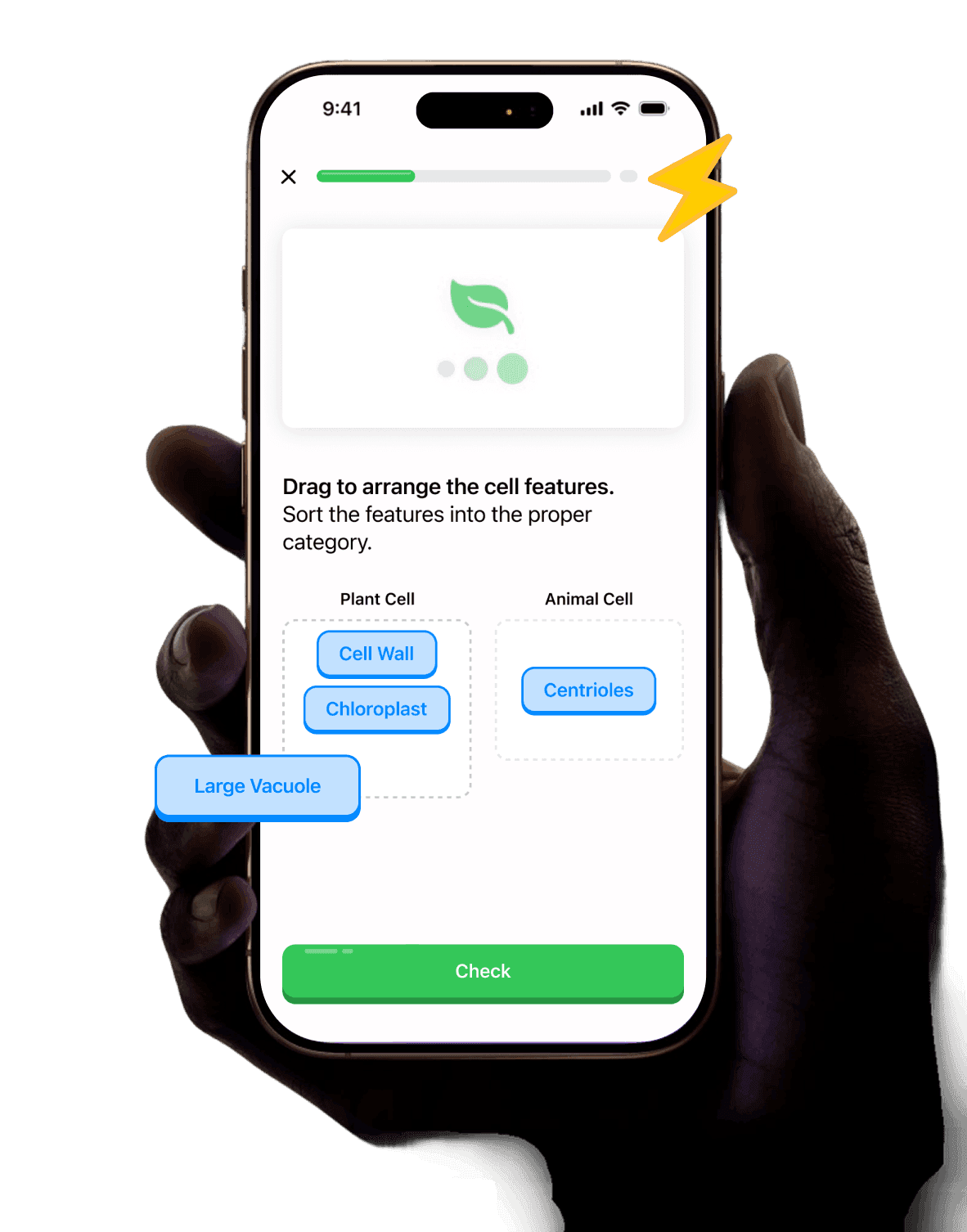
Short daily sessions, real science, and a system designed to help you remember it all.

Your New Favorite Way to Science
Short daily sessions, real science, and a system designed to help you remember it all.
Your New Favorite Way to Science
Short daily sessions, real science, and a system designed to help you remember it all.